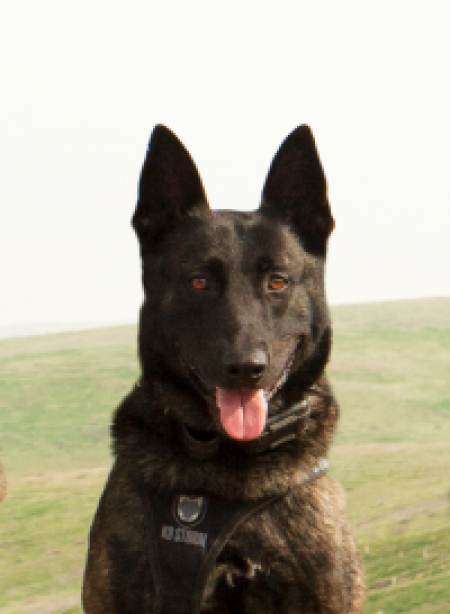
The Orange County Sheriff Department’s K9 Unit is saddened to announce the passing of retired Police Service Dog, Noa. The 15-year-old Belgian Malinois passed away Monday, April 22, after a long and successful career with the Orange County Sheriff’s Department.
PSD Noa received her initial training in Europe before joining the Orange County Sheriff’s Department to be a member of the Custody Detection Team.
Noa and her first partner, Deputy Anderson, were assigned to the James A. Musick Facility where they conducted more than 1,200 searches for narcotics and completed over 400 hours of training. When Deputy Anderson transferred to patrol operations in August of 2009, Noa was provided a new partner, Deputy Hodges.
Deputy Hodges and Noa remained at the Musick facility, where the duo made more than 20 observed felony arrests for narcotic possession at the jail, and were often called upon to help search the other jail facilities for narcotics. Noa also assisted patrol deputies on vehicle stops and probation searches in operations.
Deputy Hodges transferred to patrol in 2013 and Noa was assigned to a third partner, Deputy Raphael. Deputy Raphael certified with Noa and was in service at the Musick Facility and also assisted patrol in more than 325 deployments.
Noa retired in 2014 and was adopted by Deputy Zwirner, who was assigned to Musick and was looking to bring Noa to a loving home.
PSD Noa will be missed and remembered by her partners, Deputy Zwirner and the men and women of the Orange County Sheriff’s Department.
Every dispatcher is guaranteed to receive that first call that challenges their resolve for navigating someone else’s worst imaginable day.
Dispatcher Katie Howard received one such call in her first week off training. A mother had inadvertently fell asleep on her seven-week-old baby, and the baby had died. It was one of three calls involving young children that OCSD dispatchers fielded that week.
As a mom to two young children, Howard knew calls like these would affirm her career choice or convince her to consider another path.
“Either you can handle the stress of these calls or you can’t,” said Howard, the daughter of a retired OCSD motor deputy who joined the department 14 months ago.
Radio Dispatch Supervisor Leslie Gallant, who trained Howard, has seen the stress of the job weigh heavy on new dispatchers.
“I have seen some make it all the way through training and then they get that one call and that’s it for them,” Gallant said. “Emotionally, this is a very hard job to do.”
Howard quickly learned she was cut out for handling the tough stuff.
“It made me more focused,” she said of working intense calls. “Then, at the end of the shift, I leave it all in the building.”
Dispatchers require an ability to stay calm under pressure and multitask. However, it is their passion for helping others that draws the more than 50 dispatchers and supervisors with the Orange County Sheriff’s Department to their stations every day.
“This is the way of doing the job of a first responder without being a deputy,” said Gallant, who worked as an EMT for eight years before joining the Sheriff’s Department in 1998. “We are the first voice of contact, and we want to help. We want people to know that we are here for them.”
While tough calls are a guarantee, there are also the calls in which dispatchers know, for certain, their words made a difference.
Gallant’s call came some 18 years into her career.
A distraught victim of domestic violence called from a Lake Forest hotel for help. She was crying and didn’t know what to do next.
“She had left her situation and she was so scared,” Gallant remembers.
The woman called five more times that night, unsure she had made the right decision to leave. Gallant remained the calm, assured voice keeping the victim safe from miles away.
Days later, the woman called a final time.
“She told me, ‘You saved my life when you talked to me. I had the courage to leave and move to Los Angeles’,” Gallant recalled on a recent Thursday. “That is a call I will always remember.”
Stationed at the Emergency Communications Bureau, dispatchers field about 1,500 emergent and non-emergent calls every day.
“We never know what’s on the other end of that call,” Gallant said. “We always try to remember that when someone calls, whatever the problem is, it’s an emergency to them.”
Although, Gallant admits, there are times when it really isn’t an emergency at all.
There was the time a woman called 911 to report the strong scent of sizzling onions emanating from her neighbor’s home – a call Gallant fielded herself some years ago. Or there was the time an irate woman requested a deputy to settle an argument at a fast food chain over a poorly constructed hamburger.
“We only have so many 911 lines so we don’t want non-emergent calls tying up those lines and delaying help for someone who really needs it,” Howard said.
At the Orange County Sheriff’s Department, dispatchers are broken up into two groups: those who take the calls and those who dispatch emergency services and relay information to the deputies on the radio.
After six to eight weeks training to be a call taker, a new dispatcher will spend several months fielding calls before taking up radio training. Radio training then stretches between 16 and 18 weeks.
The radio demands clear communication skills and multi-tasking mastery. The information dispatchers provide deputies in the field dictates the initial response, so every detail matters.
“We have to control the conversation,” Howard said. “We need people to be descriptive. And we need people to know that being on the phone doesn’t delay help. As we’re talking, we’re also sending deputies.”
Getting to the crux of the emergency helps dispatchers relay the most accurate information to deputies in the field, and there is little room for error.
“We re-phrase what the caller is saying to the most necessary information, and we need to be specific” Howard said. “We want to keep our deputies safe.”
When the deputies arrive on scene that’s often when the call ends for dispatch --- an abrupt finale with no satisfaction of resolution.
Are the deputies OK? Did that caller survive? Did that child start breathing? What happened?
“We never know the outcome,” Gallant said. “But you can’t dwell. We just move on to the next call.”
The Orange County Sheriff Department is saddened to announce the passing of retired Police Service Dog, “Luna.”
Luna, a 14-year-old Belgian Malinois, passed away Sunday, March 31, comforted by her handler, Deputy Jones.
PSD Luna was born in the Netherlands in January 2005 and was certified in the sport of Koninklijke Nederlandse Politehond Vereniging, or KNPV. After the certification process, she joined the Orange County Sheriff’s Department in 2009 and received her first assignment as a narcotics detection canine.
Luna was first assigned to now-retired reserve Deputy Doug Williams and the two worked patrol for several years until Deputy Williams was transferred in 2012 to the OCSD Mounted Unit.
In January 2013, Deputy Jones was selected as Luna’s new handler and the pair was assigned to the Theo Lacy Facility to conduct narcotic sniffs inside the jail. In addition, the team would assist patrol, probation and other partner agencies with narcotic sniffs and search warrants. Deputy Jones and Luna were deployed more than 400 times to search for narcotics.
The pair also starred in many public demonstrations, in which Luna showed off her ability to quickly locate narcotics odor.
In August 2015, Deputy Jones was transferred to patrol in the City of Lake Forest and Luna was retired from service.
PSD Luna enjoyed her retirement with Deputy Jones and his family by taking daily walks, showing off for family and friends and playing fetch at the park.
Luna will be missed and remembered by her partner, Deputy Jones, his family and the men and women of the Orange County Sheriff’s Department who had the honor of working with her.
SANTA ANA, Ca. (April 3, 2019) – In the first full year of implementation of California Senate Bill 54 (SB 54), a state law that limits which offenders local law enforcement can notify Immigration and Customs Enforcement (ICE) about, the Orange County Sheriff’s Department (OCSD) transferred 717 inmates to ICE upon completion of their local sentence from Jan. 1 to Dec. 31, 2018.
Three Orange County Sheriff’s Department personnel were among 19 honorees at the March 28 Trauma Intervention Program annual Heroes with Heart gala, which recognizes first responders who go above and beyond to show empathy and compassion on the job.
TIP is an invaluable resource that first responders often call upon to be the comfort and support of those in our community who are realizing their worst day. Whether it’s responding to a fatal collision, the home of a family who has lost a loved one, the scene of a violent crime, or a hospital bed to comfort a grieving wife, TIP volunteers commit to being an emotional support to victims during traumatic events.
We are honored that TIP recognized our personnel for their compassionate approach to very difficult calls. The TIP volunteers shared, in their words, why they nominated each first responder:
Deputy Coroner Nguyen
“On October 31, 2017, I was called to Irvine to support the family after a sudden death. Deputy Coroner Nguyen was extremely helpful to the Vietnamese family, speaking to them in their native language. In addition, I was very impressed with the care and warmth with which he interacted with the family. He was responsive to all of their needs.”
- Dick Oakley
Deputy Saldivar
“On June 25, 2017, I was called to Dana Point to support the family of a son who died. Deputy Saldivar demonstrated extraordinary compassion to the witnesses of the accident who tried to revive the child and did CPR. He went out of his way to check on the distraught witness, and reassured him he did everything possible to save the child. I don’t think Deputy Saldivar had any idea what an impact his words had. At the end of the call, he tearfully hugged the witness and suggested he hold his children close.”
- Maryellen Lowrey
Deputy Vega
“On March 8, 2018, I was called to Stanton to support the parents of a child who had died. There I worked with Deputy Carlos Vega. He was an amazing deputy. At one point, the mother of the child collapsed into Deputy Vega’s arms and cried. He held her, comforting her and not saying anything, just holding her. My job as a TIP volunteer would be much more difficult without my partnership with Deputy Vega.”
Slides from the murder scene flipped onto the screen – one grotesque shot after another.
The students briefed on the infamous 2005 “Fortune Teller Murders” weren’t fazed by the blood-soaked and paint-splashed scene; they leaned in.
They learned about the complexities of processing the detailed scene and how forensic scientists played a critical role in building a case that led to the arrest of a North Carolina couple who murdered a Westminster fortune teller and her daughter after receiving a less-than-ideal reading from the clairvoyant. (I’ll link to story on this case.)
These 40 students from three Orange County high schools visited the Crime Lab and Coroner Division on Friday, March 1, for a behind-the-scenes look at the function of these two busy divisions of the Orange County Sheriff’s Department.
A play-by-play of how forensic scientists, for 21 hours, processed the scene in which the suspects stabbed the mother and daughter multiple times and then covered them with different types of white paint showcased the importance of meticulous evidence collection and thorough processing skills.
This presentation was billed as a reward for students from Capistrano Valley, San Clemente, and Santa Margarita high schools who have volunteered throughout the school year for the department’s “Next Step” program, which empowers high school students to become stewards of drug-prevention messaging to younger students.
The students were treated to an inside look of the Crime Lab, seeing first-hand how toxicology works and how certain types of evidence are processed. Then, after a lunch of pizza and potato chips, the students made their way to the Coroner Division.
“This is a reward for them, but it’s more than that,” said Deputy Chris Anderson, who runs the Next Step program. “The students will be able to learn information from our Crime Lab and Coroner that will help with their drug prevention education.”
Next Step empowers high school students to teach middle schoolers about choosing a drug-free lifestyle. The program is run similar to a school club that meets during lunch periods to discuss curriculum and best ways to reach the next generation of high schoolers who will face an unprecedented amount of peer pressure.
“This group is the most diverse group of students you probably will ever find at a school club,” Anderson said. “I have Varsity athletes, dancers, artists and theater kids. They all have chosen to live drug-free and all for different reasons.”
Next Step currently is on campus at Capistrano Valley, San Clemente and Santa Margarita high schools. To learn more about Next Step visit duila.org.
SAN JUAN CAPISTRANO, Ca. (March 25, 2019) - The Orange County Sheriff’s Department Traffic Division will launch a special enforcement effort on Wednesday, March 27, to target distracted driving in the city of San Juan Capistrano.
Many scam artists are going virtual to find new targets, but there are steps you can take to stay safe and prevent becoming a victim.
The Orange County Sheriff’s Department in recent months has seen an uptick in reports of various scams, from virtual kidnappings to faux pet purchases, in an effort to extort money unsuspecting victims.
On March 5, a San Clemente deputy was dispatched at approximately 2:15 p.m. to a bank in the 300 block of El Camino Real in response to a potential kidnapping.
When the deputy arrived, a 63-year-old man told him he received a phone call from a suspect claiming to be with the man’s 25-year-old daughter in Mexico. The caller said they were in danger, that a friend in their group had been shot, and demanded $2,000 for medical bills, paid electronically and not using a bank transfer.
The victim asked to speak to his daughter before he sent the money, but the suspect would not comply. The victim reported hearing what sounded like his daughter’s voice screaming in the background.
When the victim arrived at the bank, an employee helped by calling the Sheriff’s Department. The victim again asked to speak to his daughter, but the suspect wouldn’t comply. The victim then hung up the phone and called his daughter. She was safe at school in Oceanside.
This type of scam, commonly known as virtual kidnapping, is making the rounds in several Orange County cities. However, it’s not the only clever way crooks are trying to extort residents.
On March 20, a Mission Viejo resident was swindled out of $950 after attempting to purchase a bulldog that was advertised for sale online. The suspect asked for the payment in Amazon and Google Play gift cards. Once the suspect received the gift card code over a messaging app, the suspect then cut off communication and never delivered the dog.
Also on March 20, a Mission Viejo woman was contacted through an online dating app by a man who asked the woman to exchange $10,000 in checks for the same amount in Best Buy and Kohl’s gift cards. The woman purchased the gift cards and made the exchange only to later realize the checks were fraudulent.
These are just some examples of how criminals are getting creative. Their tactics are convincing and unfortunately are proving to be effective. However, there are things you can do to protect yourself:
If you receive a call that indicates a potential kidnapping and it doesn’t seem safe to hang up the phone, find the nearest person or drive to the Sheriff’s Department station to ask for help. You can write a note asking someone to contact a deputy who will respond.
If you are asked to pay for anything using gift cards – a dog, a purse, an alleged ransom – that’s an automatic red flag.
If someone calls claiming to be a family member asking for money, hang up the phone and attempt to reach that family member. This scam, also called “the grandparent scam,” involves suspects posing as a loved one in trouble and in need of money in the form of gift cards. Sometimes they will know basic information about your loved one and use that information in an attempt to prove the validity of their requests.
If the caller incites fear, stresses the emergent nature of the request or attempts to verbally coerce you, your suspicions should be raised and law enforcement should be contacted.
Phone a friend (aka the Sheriff’s Department). If ever you receive one of these calls and are unsure about what to do next, please call the Sheriff’s Department at 714-647-7000 (Press 1, then 9). We are always happy to assist!
Spread the word. When you hear about a new scam making the rounds, talk about it with friends and family. Education and awareness is key in preventing virtual fraud.
LAGUNA HILLS, Ca. (March 18, 2019) - The Orange County Sheriff’s Department Traffic Division will launch a special enforcement effort on Thursday, March 21, to target distracted driving in the city of Laguna Hills.
LAGUNA HILLS, Ca. (March 18, 2019) – The Orange County Sheriff’s Department will step up bike and pedestrian safety enforcement operations throughout the county on Friday, March 22, with focused enforcement on collision-causing factors involving motorists, pedestrians and bicyclists.